What Are Peptides? A Nurse Explains Why Everyone Is Suddenly Talking About Them

Some links on my site are affiliate and brand partner links. I may earn a commission at no extra cost to you. Nothing here is medical advice.
JUMP TO:: MEDICAL, BRAND PARTNER, & AFFILIATE LINK DISCLOSURES

If you’ve been seeing people talk about peptides, peps, peppers, pepper gardens, or some weird version of the word peptide typed like it came from a ransom note, and you’ve been wondering what in the actual wellness internet is going on, you aren’t alone. It’s come to my attention that a lot of people are watching us talk about peptides like we have two heads because they have no clue what we’re even talking about or why they seem to be everywhere right now. And honestly? Fair.

Before I became more involved in the wellness side of things, I understood the basic science of peptides, but I didn’t fully understand how they were being used in longevity, skin health, energy support, recovery, metabolic health, or the newer wellness conversations happening online. I knew peptides existed in the body. I knew they mattered. But I wasn’t sitting around casually talking about peptide therapy over coffee like that was a normal Tuesday.

Why is everyone talking in code about peptides?

Before we even get into what peptides are, we need to talk about why you might see people calling them peps, peppers, pepper garden, 🌶️🌊, or some bizarre character version like Pɛp+ḷꝺΣ. It can look ridiculous from the outside, and to be clear, sometimes it IS ridiculous. But there’s a reason for it.

Social media platforms are not great at telling the difference between someone in the healthcare or wellness space providing legitimate educational content and someone selling gray market research peptides like they’re selling illegal drugs on the corner. So the people who are trying to talk about this responsibly often end up getting creative with language because platform filters can flag the topic before even getting to the context.

That doesn’t mean every coded post is trustworthy, and it definitely doesn’t mean every person using normal wording is unsafe. It just means the online peptide conversation has gotten weird because the internet made it weird. Shocking, I know.

So what are peptides?

Peptides are already in your body. They’re not some random wellness invention someone cooked up because they ran out of collagen powder to sell. Peptides are short chains of amino acids, and amino acids are the building blocks your body uses to make proteins.

Think of it like language. Amino acids are the letters. Peptides are short words or phrases made from those letters. Proteins are the longer sentences, paragraphs, or full instruction manuals made from those same letters arranged in more complex ways. That’s the simplest way to understand the relationship without turning this into a biochemistry class, which I promise nobody asked for today.

Peptides can act like messengers in the body. Depending on the peptide, that message may relate to skin health, collagen support, recovery, metabolic signaling, appetite signaling, cognitive function, tissue support, immune signaling, or cellular repair. That’s why the phrase “I take peptides” is honestly not very specific. It’s kind of like saying, “I take medication.” Okay… which one? For what? Through what route? Under whose guidance? For what goal?

What Are Peptides Used For? It Depends on the Peptide

This is one of the biggest things people miss when they first start hearing about peptides. Peptides aren’t all the same. They don’t all do the same job, and they aren’t all used for the same reason.

Some peptides are talked about for energy and cellular function. Some are being explored for skin, collagen, and tissue support. Some come up in conversations around muscle recovery, joint comfort, or workout recovery. Some are discussed in cognitive wellness. Others are connected to metabolic health and appetite signaling. Even within the same general category, two different peptides may work through completely different mechanisms in the body.

That’s why I don’t love when people ask, “What peptide should I take?” as if there is one universal answer. The better question is, “What am I trying to support, and what does my health history actually look like?” Because the peptide conversation for a woman who’s exhausted but sleeping fine may look very different from the peptide conversation for a woman dealing with skin changes, hair thinning, workout recovery issues, brain fog, or metabolic changes.

Why Women Over 40 Are Interested in Peptide Therapy for Energy, Skin, and Recovery

A lot of women aren’t peptide curious because they want another trendy wellness thing. They’re curious because something changed, and the old tools aren’t working the way they used to.

Maybe your skincare routine used to be enough, and now your skin still looks tired no matter how consistent you are. Maybe the Botox still smooths the lines, but it doesn’t fix the dullness, the skin laxity, the crepey texture, the volume loss, or the fact that your face still looks tired underneath it all. Maybe you’re working out, eating well, sleeping okay, and still dragging by 2pm. Maybe your recovery from workouts feels slower than it used to. Maybe your hair feels thinner, your body composition is changing, your brain feels foggy, or maybe your skin just doesn’t bounce back the way it used to. It’s annoying as hell because you’re still doing the skincare, the SPF, the appointments, all of it.

Then you go to your doctor, get the usual labs, and hear, “Everything looks fine.” Which is frustrating because “fine” does not explain why you feel exhausted, your skin looks different, your workouts take longer to recover from, and your body responds differently, even though your routine hasn’t changed.

That is where a lot of women start researching peptides. Not because they’re trying to become one of the bodybuilding biohacker bros. Not because they want to chase every shiny wellness trend. They’re trying to understand what’s happening under the surface and whether there are smarter options than just doing more of the same.

Are peptides FDA approved?

This is where we need to be specific, because “peptides are not FDA approved” is too broad.

Some FDA approved medications are peptide based or peptide related, like GLP-1s. But many of the peptides being discussed online in the wellness, longevity, recovery, skin, and performance spaces are not FDA approved medications. Compounded medications are also not FDA approved, which means the FDA does not evaluate them for safety, effectiveness, or quality before use.

That can sound scary, but it doesn’t automatically mean something is bad or unsafe. It means the details matter a lot. It means you need to care about who is evaluating you, where the medication is coming from, whether the pharmacy is licensed and regulated, whether testing is being used to verify quality, whether the instructions are clear, and whether there is actual support if you have questions or concerns.

This isn’t the category where I want anyone playing mystery vial roulette because a website had sophisticated branding and a price that looked too good to be true.

I know “not FDA approved” can sound scary, so let’s put that phrase in context. Dietary supplements, including many vitamins, minerals, and wellness products people buy every day, are also not FDA approved for safety and effectiveness before they hit the market. That doesn’t automatically make them bad, but it does mean the quality, sourcing, claims, testing, and company behind them matter.

The same general idea applies here, but with an important distinction: many peptides being discussed in wellness are not supplements. They are often compounded medications, which means they belong in a more medically guided lane. Compounded medications are not FDA approved, and that is exactly why provider review, a licensed pharmacy, clear instructions, and testing standards matter so much.

How to Choose a Peptide Source: Provider Review, Licensed Pharmacies, and Quality Testing

You can find almost anything online. That doesn’t mean you should put it in your body.

One of the biggest issues with peptides right now is that a lot of people don’t understand the difference between medically guided options and research grade gray market products. Some websites look polished. Some use medical language. Some have branding that feels legitimate at first glance. But clean branding doesn’t automatically mean provider oversight, proper pharmacy standards, clear dosing instructions, sterility, potency, purity, or support.

My green flag list is boring on purpose. I want licensed provider review. I want a licensed and regulated compounding pharmacy. I want third party testing for potency and purity. I want clear instructions. I want actual support if I have questions or concerns. I want transparency around what is compounded and what isn’t FDA approved. I want the process to feel medically guided, not like someone tossed you into the internet wilderness with a vial and a prayer.

That is the difference between “this exists online” and “this is a source I’d actually be comfortable putting my name next to.”

Why I Use EllieMD for Provider-Reviewed Peptide and Wellness Options

I personally use EllieMD, and I’m also a brand partner with them. That means yes, I may earn from qualifying orders through my link. It also means I’m putting my name, my nursing background, and my personal standards next to the company I’m choosing to talk about publicly.

The reason I talk about EllieMD isn’t because peptides are trendy. It’s because I wanted a source that checked the boxes I care about as a nurse and as a woman using some of these tools myself. And I wanted to have a trusted source to be able to recommend when I’m asked questions about peptides. Licensed provider review matters. A regulated pharmacy process matters. Clear instructions matter. Support matters. Quality standards matter. And not making people feel like they have to decode this entire category alone matters too.

For the woman who is already investing in skincare, med spa treatments, wellness tools, supplements, fitness, and better health, this is not about finding the cheapest option. It’s about asking whether the next investment actually makes sense, whether it is medically guided, and whether it is addressing the thing you’re actually trying to support.

Do peptides replace your doctor, labs, skincare, nutrition, or strength training?

No. And anyone making it sound that simple is already making me nervous.

Peptides are not a replacement for medical care. They are not a replacement for appropriate labs, nutrition, strength training, sleep, hormone evaluation, skincare, or an actual provider who understands your health history. They are one category of tools that may be worth discussing depending on your goals, medications, history, labs, budget, and what you are actually willing to do consistently.

The right conversation depends on the person. One woman may be looking at peptides because she’s sleeping fine but still exhausted. Another may be more focused on skin changes, collagen support, hair thinning, slower workout recovery, brain fog, libido, sleep, or metabolic support.

And for some people, peptides may not be the right fit at all. That is exactly why provider review matters.

That is why provider review matters. That is why your health history matters. And that is why I will never be the person telling everyone on the internet to take the same thing because one person had a good experience.

How to Know Which Peptide Might Fit Your Wellness Goals

If you’re new to peptides, I wouldn’t start with, “What is the best peptide?” I’d start with, “What am I actually trying to support?”

Are you looking for help with energy? Skin texture? Collagen support? Hair changes? Workout recovery? Brain fog? Metabolic health? Sleep? Libido? Joint comfort? Inflammation? Are you already taking medications or supplements? Do you have recent labs? Do you have a medical history that needs to be reviewed? Are you willing to give yourself injections, or do you need a nasal spray, capsule, or troche option? What are you actually going to use consistently?

Those questions matter more than whatever peptide is getting the most attention online this week.

Peptide Therapy for Women: What to Understand Before You Start

Peptides are not new. They aren’t magic internet dust. They’re not all the same. And they are definitely not something I’d recommend buying from a random research use only website because the pricing looked shockingly good.

Peptides are short chains of amino acids that can act like messengers in the body. Different peptides have different jobs, and some are being used or studied in wellness areas like energy, skin health, collagen support, recovery, tissue support, metabolic health, and cognitive function.

But the source matters. The provider matters. Your health history matters. Your goals matter. And whether this actually makes sense for you matters more than whatever the internet is screaming about this week.

If you want help narrowing down what might fit your goals, start with this peptide quiz. It will give you a personalized plan based on your unique goals and history. And if you get your results and you still want to talk through your options in more detail with me, I’m always available to help.

Why is my pee blue? The “OG” Secret for Brain Fog and Energy

Some links on my site are affiliate and brand partner links. I may earn a commission at no extra cost to you. Nothing here is medical advice.
JUMP TO:: MEDICAL, BRAND PARTNER, & AFFILIATE LINK DISCLOSURES

Let’s be real for a second. If you looked down and saw blue or blue-green pee in the toilet, you’d probably freak out just a little, right? But what if I told you that “blue pee” is actually the latest buzz in the wellness world for kicking brain fog to the curb?

We’re talking about Methylene Blue.

If you’ve been feeling like your brain is stuck in a permanent mid-afternoon slump, or if perimenopause has invited “brain fog” to live in your head rent-free, you’re going to want to read this.

What is Methylene Blue? (And no, it’s not a TikTok trend)

While it might be trending on social media, Methylene Blue is actually the “OG” of medicine. It’s a pharmaceutical-grade compounded dye that has been used by doctors and hospitals for over 150 years.

Unlike those random supplements you find in a late-night scrolling session on an online marketplace, the version I’m obsessed with is prescribed and overseen by licensed medical providers through EllieMD.
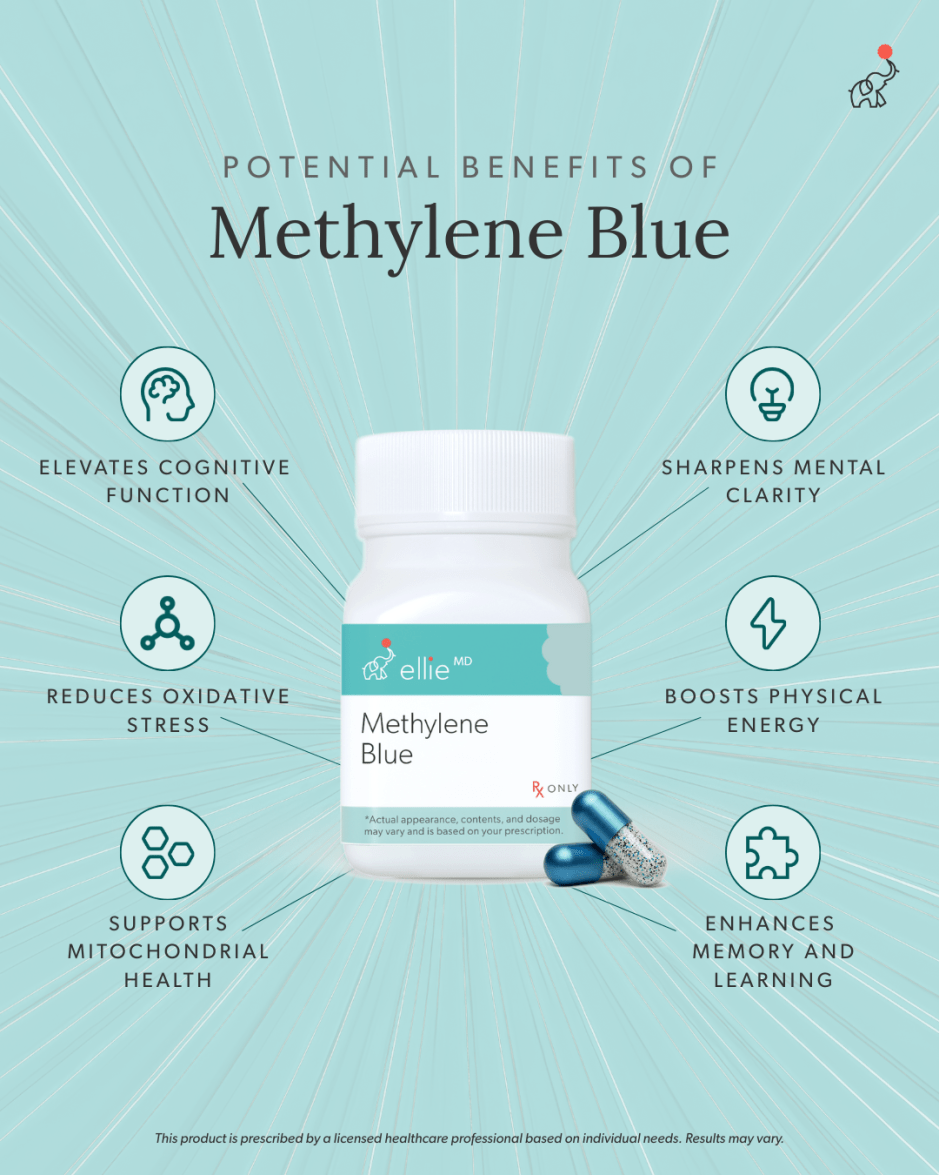
Infographic showing potential benefits of pharmaceutical-grade methylene blue, including cognitive function, mental clarity, cellular energy, and mitochondrial support.
Methylene blue is being studied for its potential role in supporting cognitive function, cellular energy, and mitochondrial health.

The “Blue Pee” Mystery Solved

First things first: the blue pee. It’s totally normal! It’s just a sign that your body is processing the Methylene Blue exactly how it should. Your system takes what it needs for cellular energy and flushes out the rest.

Pro-Tip: If your 💩 turns blue, that’s a different story. That’s a “call your provider” moment because it means your body isn’t breaking it down quite right.

Why Women are Reaching for Methylene Blue for Brain Fog

If you are in the perimenopause trenches, you know that energy isn’t exactly predictable anymore. One minute you’re fine, the next you’re hitting a wall that even an Alani can’t fix.

Methylene Blue is being studied for its potential to support:

  • Mental Clarity: Helping you find your keys (and your train of thought).
  • Physical Energy: Boosting how your cells turn oxygen into fuel.
  • Cognitive Function: Supporting long-term brain health and memory.

Steady Support, Not a Caffeine Crash

The best part? This isn’t a stimulant. You won’t get those shaky, “I had too much espresso” jitters. Think of it less like a quick caffeine spike and more like a slow, steady stream of support for your cells.

It’s all about mitochondrial health. When your “cellular batteries” are running low, it doesn’t just feel like you’re tired. It feels like a total lack of motivation and true mental fatigue.

Why the “Pill” Version is a Game Changer

I know a lot of us in the wellness space are used to injections, but let’s be honest: sometimes we just want things to be simple.

If you’ve been looking for ways to increase energy without more shots, you are going to love this. Our version is a simple pill. No needles, no fuss, just pharmaceutical-grade support tailored to your individual needs.

Is Methylene Blue Right for You?

There is so much nuance to this conversation, especially since it’s even being studied in relation to Alzheimer’s and long-term cognitive care. Because it’s so unique (and because it turns your pee blue!), it’s hard for scientists to do “blind” studies, which is why it stays such a hot topic for research.

If you’re ready to stop guessing and start supporting your brain health with something backed by science, let’s chat about adding this to your routine.

CLICK HERE TO BOOK A FREE 15 MIN CALL WITH ME

OR YOU CAN JUST TEXT ME YOUR QUESTIONS

Beyond Weight Loss: The Nurse’s Guide to Microdosing GLP-1s and NAD+

Some links on my site are affiliate and brand partner links. I may earn a commission at no extra cost to you. Nothing here is medical advice.
JUMP TO:: MEDICAL, BRAND PARTNER, & AFFILIATE LINK DISCLOSURES

Are you tired of feeling tired?

I hear it every single day. You are exhausted, you are experiencing brain fog, and you feel like your body is fighting against you. You tell yourself you will prioritize your health “after the holidays” or “in January.”

But as a nurse, I am here to tell you that exhausted is not a personality trait. And accepting that feeling drained is “just a part of aging” is not an option.

If you have been curious about the buzz surrounding GLP-1s but are hesitant because you don’t want to just “lose weight”—or if you are in that perimenopause transition and looking for a way to feel like yourself again—it is time to look at the science of microdosing.

This isn’t about a quick fix. It is about longevity science. And right now, there is a special opportunity to start this protocol with a massive advantage (more on that at the end).

What is Microdosing?

When most people hear about GLP-1s, they think of aggressive weight loss. But there is a different approach: Microdosing.

Think of microdosing as whispering to your metabolism instead of screaming at it. We aren’t trying to completely silence your appetite or force rapid changes. We are supporting the body’s natural functions to correct metabolic dysfunction.

11 Benefits of Microdosing GLP-1s (That Have Nothing to Do with the Scale)

While weight management is a fantastic side effect, the systemic benefits of this peptide therapy are what truly excite me as a healthcare provider.

  1. 1mproved Insulin Sensitivity It helps regulate blood sugar levels, making it easier to support insulin sensitivity. This is vital for reducing the risk of metabolic syndrome, which becomes much more common during perimenopause.
  2. Hormonal Balance Support For my perimenopause and menopause ladies, this is huge. It can help manage the hormonal imbalances related to insulin and estrogen. It can also positively influence cortisol levels, reducing the toll chronic stress takes on your body.
  3. Brain Health & Cognitive Function Brain fog is one of the biggest complaints I hear from women in midlife. GLP-1s have neuroprotective benefits that support cognitive function and mental clarity.
  4. Cardiovascular Health It improves lipid profiles by supporting healthy cholesterol levels and reducing blood pressure by improving vascular function.
  5. Quiet the “Food Noise” Microdosing helps suppress that constant mental chatter about food. It promotes satiety so you can make conscious, healthy eating habits without feeling deprived.
  6. Gut Health By slowing gastric emptying, it improves digestion and nutrient absorption. A healthier gut microbiome is linked to better immunity and reduced inflammation.
  7. Anti-inflammatory Effects Systemic inflammation is a root cause of so many chronic issues, including arthritis and skin aging. Lowering inflammation supports your whole body.
  8. Muscle Maintenance Unlike aggressive dieting, microdosing helps preserve muscle mass. This is essential for longevity and strength as we age.
  9. Metabolic Health Boost It enhances overall metabolic function, teaching your body to use fat as an energy source more efficiently.
  10. Emotional Well-Being Stabilizing blood sugar levels has a direct impact on your mood. This can help reduce the anxiety and stress often associated with feeling out of control of your health.
  11. Long-Term Prevention This is a proactive tool. It supports longevity by addressing core health issues that become prevalent in midlife, promoting overall vitality.

Why You Should Pair It With NAD+

If the GLP-1 Microdose is the steering wheel keeping you on the road, NAD+ (Nicotinamide Adenine Dinucleotide) is the gas in the tank.

NAD+ is a vital coenzyme that fuels your cells. As we age, our natural levels drop, leading to fatigue and slower cellular repair. Supplementing with NAD+ provides a “cellular battery” boost.

  • It boosts energy by converting nutrients into ATP.
  • It supports DNA repair to slow the aging process.
  • It improves metabolism to assist with weight management.

The “Nurse’s RX” Synergy

Why do I recommend these two together? Because they solve the puzzle from two different angles.
A common struggle when changing your metabolism is temporary fatigue. NAD+ directly counteracts this by boosting your cellular energy. While the Microdose regulates your hormones and insulin, the NAD+ optimizes the cellular machinery that burns the fuel.
It is the ultimate “Metabolic Momentum.”

A Special Opportunity to Start

I am a big believer that the best time to start was yesterday, but the second-best time is right now.

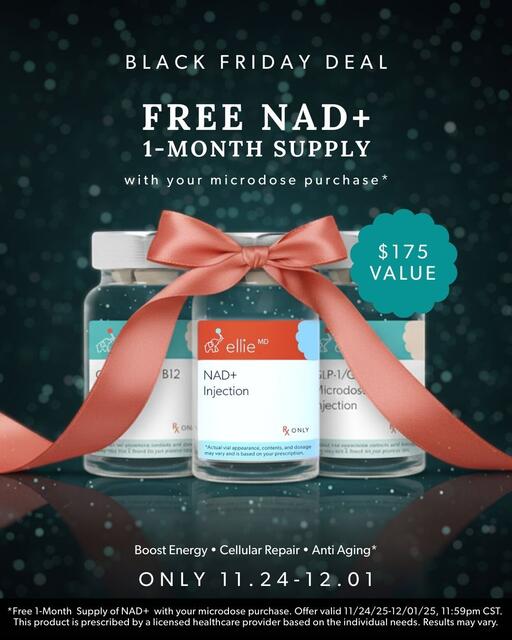
For a limited time, we are offering a special bundle to help you kickstart your longevity journey. When you purchase a Longevity Microdose kit, you will receive a 1-month supply of NAD+ for FREE. (This is a $175 value included at no cost.)

Black Friday Deal graphic showing a free 1-month supply of NAD+ Injection ($175 value) with an Ellie MD GLP-1 Microdose purchase. Three medical vials wrapped in a festive red bow.
Don’t miss the biggest wellness deal of the year: Get a free month of NAD+ ($175 value) when you start your longevity microdose protocol. Valid Nov 24 – Dec 1.

You do not have to go “all in” to see changes. You just have to start. This is your chance to get a massive boost while dipping your toes into a protocol that addresses the root causes of how you feel.

Six months from now, you will be so glad you didn’t wait for January.

Shop The Longevity Special